Restoration Rendering-Tyler Rae/Jim Ryan Jr.
Showing posts with label Turfgrass Diseases. Show all posts

Tuesday, August 8, 2023

High Rough/Seeding Trials

The season continues to move along at Hyde Park, with the Art Smith in the rearview mirror our team is focused on giving the greens a little of a break with the added stresses on the turf from multiple mowings and rolling to achieve a true surface.  We are utilizing tools such as fans and venting of the surface to allow for oxygen exchange and dry the surface. USGA VIDEO LINK  There are areas of turf that have "thinned" but are largely confined to certain varieties of bentgrass.


Our annual mowing of the "high rough" areas has begun across the golf course in anticipation of fall herbicide applications, these areas are usually mowed two-three times each season depending on the weed encroachment. In many areas the grass clippings will be mulched and blown to disperse.


Between the 10th and 11th hole we have begun an establishment trial of fine fescues to see if we can create a low input rough area that is playable. This area will consist of Sheep and Hard fine fescues with different seeding rates. 

Rectangle- Trial Area 

If you have any questions please reach out to us grounds@hydeparkcc.com. We appreciate your feedback!


Thank-you,

Pat O'Brien

Grounds Superintendent 


Tuesday, June 16, 2015

The Heat is on! Keep Cool.

The past week has been very hot, humid and most likely it is going to get wet! Many of you know from our conversations on the golf course or on the putting green I prefer the playing conditions to be on the drier side of the continuum for both playability and plant health. We can always add water, but it is very difficult to take it away, unless there is adequate drainage. Saturated soil conditions reduce the amount of oxygen available to the root systems. Water, is also an excellent conductor of energy, when soil temperatures rise, the root systems begin to slough off and the plant becomes ineffiecnt at uptaking the necessary water and nutrients to survive.

Some of the tools that help us reduce stress to the plant in these challenging weather patterns include; careful monitoring of moisture in the rootzone with a moisture meter. The Grounds Staff utilizes moisture meters to determine how much water needs to be added during the course of the day based upon weather conditions and other factors. Moisture data is recorded both in the morning and afternoon with the form below and is disseminated to the staff.
 
Data is recorded using this form
Moisture Meter

The Grounds Staff on a hot day will be adding supplementary water to cool the plant, this will only take a couple minutes, please wait until they are finished before hitting you're approach shot to the green.

Some of the other practices/tools we employ to enhance turfgrass survival are:
  • Applying plant protectants to all surfaces to reduce plant pathogens
  • Use of "Turning boards" to reduce stress on collars
  • "Venting" -placing a small .250" diameter hole about 2" into the surface allowing for increased oxygen exchange

  • Fans- help circulate air, reducing canopy temperatures.

These are just a few of the key strategies we utilize to help enhance plant health. If you have anymore questions please do not hesitate to contact me.

Thank-you,

Pat O'Brien

Grounds Superintendent


Wednesday, August 21, 2013

Aerification is complete- what's next?

Aerification of the putting surfaces was recently completed with excellent results even considering the warmer temperatures. The timing of aerifcation has been much earlier compared to past years because:

  • Warmer temperatures allow for faster healing
  • Slower golf calendar of events
  • Allowing to promote bentgrass over the dreaded Poa

The healing process has begun with the turf growing well. The recent trials prior to this aerifcation have yielded 75% recovery in 6 days. Thanks for your patience during this important process.

Thanks to all the staff for their efforts!

Interseeding in the rough areas continues with germination occurring after 5 days. Please remember to operate the golf carts in the Zoysia fairways to allow increased germination.

Aerification and seeding equipment

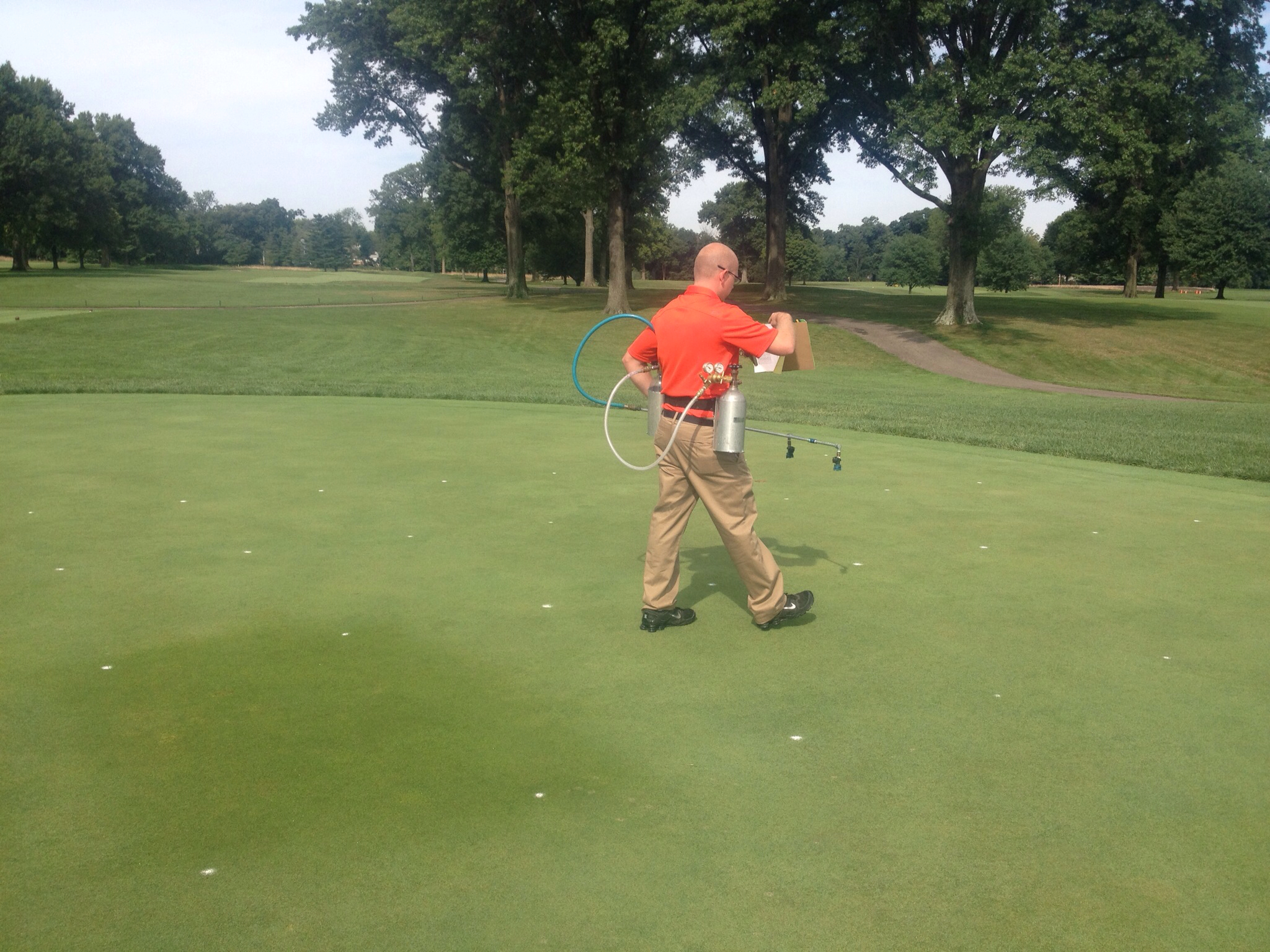
Recently questions have been asked about the white dots on the putting green? These white dots outline plots set-up by Ohio State to evaluate products that may reduce the impact of Fairy Ring. Fairy Ring is one of key plant pathogens we target each season.

Dominique making applications to putting green


Another great intern project this season was the expansion of the bentgrass sod nursery near the vegetable garden behind the 4th green. Germination is moving nicely and this areas will be ready to mow within a week. Two different bentgrass cultivars have been planted to evaluate eventually on a small scale on the putting surfaces at HP. Once established, please come and roll a few balls on these fine surfaces.


For the latest on the Grounds of Hyde Park please follow us on twitter @pobrienhpgcc or find us on the HP App.

Thank-you,

Pat O'Brien

Grounds Superintendent

Tuesday, July 16, 2013

Golf Course Update

The past couple weeks have been a challenging stretch, the weather has been very uncooperative with excessive rain amounts totaling almost 6 inches in a 7 day period and now the first stretch of high day and nighttime temperatures are here, all of which puts tremendous stress on the Turfgrass plant. Similar, to the human body, Turfgrass does not respond well to extremes.

Currently the staff and I are involved with mid-summer practices/ projects which include:

-Ventilation and light topdressing to putting surfaces reduce stress to allow the surfaces to dry faster as well as increasing air in the root zone.


-Careful monitoring of all pests including pathogens such as Summer Patch that will weaken the Poa further

-Continued focus on moisture management of putting surfaces
-Repair and addition of drainage on 4 and other areas


Other Initiatives include:

  • Herbicide applications in high rough areas
  • Deep tine aeration on zoysia grass
  • Bentgrass nursery expansion on 4
  • Cart path repairs

Thank-you,


Pat O'Brien

Grounds Superintendent


Saturday, July 6, 2013

Golf Course Update-July 6th:Course Closed

Unfortunately, Mother Nature is not cooperating, we have officially have accumulated over 4 inches of rain since July 1st. The golf course will remain closed today (July 6th) and we will continue monitor conditions for a possible opening on Sunday. Please stayed tuned for the latest updates concerning course conditions on twitter (@pobrienhpgcc) the HP App. or contact the golf shop.

-Hole 5- July 6th 9:15am-

Thank-you for your patience.

Pat O'Brien

Grounds Superintendent


Wednesday, May 8, 2013

White Putting Surfaces

As of late there has been many questions concerning the putting quality and appearance of the putting greens (except #1 green). Every spring the Poa Annua (Annual Bluegrass) begins to flower producing white seeds that make the greens have a white appearance and putt very poorly. As many of you know, Annual Bluegrass is not the desired turf grass for the putting surfaces. This grass is not heat tolerant, has poor putting quality, more susceptable to fungal pathogens and quite frankly costs more to maintain then bentgrass with increased labor, fertilize and pesticides. Some of the greens at Hyde Park are composed of 50 percent Annual Bluegrass.

Annual Bluegrass is an opportunistic plant, although difficult to control it can be accomplished with a strategic approach, after 9 years 1 green has less then 5 percent and these populations will continue to decline with new technologies in the market place.

Thank-you,

Pat O'Brien

Grounds Superintendent


Tuesday, September 11, 2012

Unusual Spots on the Greens

-------------------
Over the past two weeks a series of yellowish-bronzed sunken spots have been noted on many of the putting surfaces at Hyde Park. At this point the 3rd green has seen the most damage mainly on the Poa annua, but it looks as though the older bentgrasses are being impacted as well. The new bentgrass varieties along with 1 green (sand-based) have not been infected. Samples of turf and root zone have been sent multiple times to accredited labs to test for pathogens (fungi). Unfortunately, the results have come back negative early in the process, leaving us little information on how to treat the decline. Finally, on Friday, 7th a Plant Pathologist from the University of Wisconsin found spores for a pathogen called Pythium Root Rot (typically seen on poorly drained areas). It is difficult to determine if this pathogen is the primary or secondary cause of the decline. We have been treating the infected greens with multiple applications of three different fungicides to target Pythium Root Rot. You will also note that there are also red paint dots located on a few of the greens to allow us to determine if the areas are expanding.. Untreated areas have been also set up to monitor treated vs untreated.

We continue to work with Plant Pathologists, colleagues, University extension agents and consultants to determine if this is primary cause behind the decline. We will continue to update the membership as more information is available.

If there are comments or questions please do not hesitate to contact me. (grounds@hydeparkcc.com)

Initial symptoms on turf

A view of the 3rd green


Thank-you,

Pat O'Brien

Grounds Superintendent


Friday, July 20, 2012

Summer Patch

Over the past few weeks a few more yellow rings have been evident on the greens at Hyde Park. With the extreme temperatures and added stress to the turf such as mowing, rolling and regular traffic the annual bluegrass or Poa Annua has been working overtime to survive.  

As many of you know Poa Annua (Poa) is an undesireable turfgrass plant. With the majority of the greens at Hyde Park being over 90 years old, the populations of Poa can be almost 60 percent. Poa is undesireable because it is a shallow rooted plant that prefers moist shaded conditions. It is a prolific seed producer, creating a bumpy surface particularly in the spring time and in the summer it declines rapidly due to heat and fungal pathogens from Summer Patch and Antracnose to name a couple.

The yellow or unhealthy area is Poa, while the healthy area is green and composed of creeping Bentgrass

So what are the yellow rings? The yellow rings are symptoms of Summer Patch, a fungal root pathogen that infects the Poa plant in the spring, while the signs of the infection are only noticeable in the summer under stress conditions. We target this pathogen in the spring with multiple applications of acidifying fertilizers, and fungicides to slow the demise of the Poa. Curative applications have been erratic in controlling this disease at HP.

In the short- term we will continue to monitor the progress of the Summer Patch, trying to offset the effects on playability through sand topdressing, fertilization and promotion of creeping Bentgrass.

In the long-term, encouraging Creeping Bentgrass will improve the playability and health of the putting greens. The building blocks of a healthy putting surface include; added sunlight, aggressive topdressing and aerification, improving air movement, proper moisture management, and the addition of internal drainage to the putting surfaces.

A look back from 7 green to the shaded 6th green.

Thank-you,

Pat O'Brien

Grounds Superintendent

Tuesday, June 5, 2012

Fairy Ring- An Olympic Year

The end of the spring is near and with the warm temperatures, dry soil followed by almost an inch of rain some interesting rings are starting to emerge on the greens. These darker circles are called Fairy Rings consisting of various types of fungi in the soil and thatch. These rings, in most cases can be a cosmetic problem but depending on the type of fungi that have colonized these areas, they can cause localized dry spots and or cause issues with root growth. Generally, Fairy Rings are noted on the greens at Hyde Park each year. In order to reduce the severity of the Fairy Rings, preventative fungicide applications were applied in March and have continued to this date. Venting, applications of wetting agents ( allow water to penetrate these hydrophobic areas) along with hand watering will aid in reducing the severity of these rings.


#5 Green Hyde Park

Thank-you

Pat O'Brien

Grounds Superintendent